Monday, December 16, 2013

Winter Aromatherapy Quick Tip

Winter Solstice is coming up,
but the cold, dry weather is already here.
We need all the help we can get to keep our insides and outsides from becoming dehydrated.
One easy tip?
A simplistic, passive humidifier using just a bowl of water on top of your radiator.
Bonus: add essential oils to the mix.


Although this works best with the old-style radiators, even small baseboards radiators can be used by using ramekins or finger bowls instead of full-sized bowls (just fill them up more often).
Just fill your bowl (or ramekin, or mug, or whatever heat and water-proof vessel you choose) with water.
Add 3-5 drops of essential oils.
Put on your radiator.
And that's it!
Check every couple days and refill as needed.
The radiator gently heats the water, and the water gently heats the oil.
Water vapor and a subtle aroma are released into the air.
Don't know where to start? Try one of these combinations:

4 drops eucalyptus
1 drop peppermint

2 drops peppermint
3 drops bergamot

2 drops juniper
2 drops lemon

3 drops lavender
2 drops rosemary

1 drop German chamomile
3 drops lavender

Happy winter!

XoXo,
Lisa


Ecommerce Software by Shopify Craftybase inventory software for handmade sellers

Friday, October 11, 2013

DIY Natural Air Freshener

DIY Natural Air Freshener

Make Your Own Natural Air Freshener at Home

in just five easy steps:

  1. add 1/4 cup baking soda to a glass bowl
  2. add 5-10 drops essential oil
  3. mix and crush lumps
  4. stir in 1/2 cup dried flowers
  5. pour into decorative bowl or vase
In this example I used lavender, but any dried flower or herb will work. Match up the essential oil for best results (e.g. dried rose petals with rose absolute or essential oil, cedar chips with cedar essential oil). For a light oil like lavender, 10 drops is better, but for heavier oils like rose or cedar, less drops will work. Mixing the baking soda with the essential oils before adding the herbs allows for better blending.

Once in the bowl or vase, this freshener will help pull the bad aromas from the air while releasing the good aromas. How does that work? Magic! No, just kidding. I don't know how it works, I just know it does, and it's long lasting. A blend I had in my bedroom (it was lavender) lasted for six years before a spill caused me to stop counting. Just give the container a little shake whenever you want to release fresh aroma.

Although this is a natural air freshener, keep the mixture away from kids and pets, or anyone who might think it's a good idea to eat it (don't eat it).

XoXo,
Lisa


Ecommerce Software by Shopify Craftybase inventory software for handmade sellers

Tuesday, September 24, 2013

You Don't Know What Homeopathic Means.

Ok friends, it's rant time again.

I'd like to scream this to the world...

Homeopathic is not the same as natural.
Homeopathic is not the same as holistic.
Homeopathic is not the same as botanical.

If you use this word for anything other than one small branch of holistic medicine,

you don't know what homeopathic means,

so please find out what it means or stop using it. Especially if you're a writer/blogger. Or any part of a natural healthcare or natural skincare field. (If you're a person not involved in these fields, and you're misusing this word, it's no wonder since "authority"-types are doing it.)

At a herbal conference earlier this year I continuously heard people call small doses of tinctures "homeopathic doses". I don't know what teacher is telling their students that small means the same as homeopathic, but it's wrong. So wrong. This was especially disturbing because if anyone (other than a homeopath) should know what homeopathy is and isn't, it's a herbalist.

But, this rant was brought on by an article on natural beauty products. Not quite as disturbing, but just as annoying.

Why does it bother me so much when this word is constantly used incorrectly? Because it would be like calling all colors blue, or all foods pizza, or all mammals cats. It's just wrong. Completely.

So, what is homeopathy?

It's a branch of holistic medicine using remedies made in a very specific way. These remedies are the only things that can be called homeopathic. A homeopathic remedy is created by making a "mother tincture", and then repeatedly diluting the tincture using a technique unique to homeopathy. The end result is an energetic medicine with none of the original (botanical or other) ingredient left in the menstruum (the liquid). It's a fascinating and controversial field, but unless you are practicing it or using it, all you need to know is this:

All homeopathy is natural (some are even made from natural poisons), but not all natural is homeopathic; all homeopathy is holistic, but not all holistics are homeopathic; all homeopathy is not botanical (there is even a remedy made from fire!), and not all botanicals are homeopathic.

So, please, help me stop this insanity.

If you hear or read someone incorrectly using the term, gently let them know that homeopathy is a branch of holistic medicine, not a general term. With bloggers and other writers, some herbalists, and others continuously misusing the term, it's no wonder that so many people are confused by the terminology.

Lets set the world straight.

Also see 5 Most Commonly Misused Natural Terms for more terms commonly confused.

XoXo,
Lisa


Ecommerce Software by Shopify Craftybase inventory software for handmade sellers

Monday, August 26, 2013

Martha Stewart's American Made Nominee!

Martha Stewart's new American Made program (this is the second annual) supports handcrafted, American-made business. This year, Wunder Budder is a nominee!

There are six categories: food, craft, design, style (this includes skincare, and is the category for Wunder Budder), technology, and garden. The winner of each category will win a gift basket, a feature on the American Made website, and a mention on Sirius radio. The exposure alone could change the life of a business (hopefully Wunder Budder's!), but these category winners will go on to compete for the grand prize: $10,000, a trip to the American Made Workshop, and a feature on marthastewart.com!

Wunder Budder stands a chance to win it all, but not without your help. The contest is entirely based on votes. Entirely. The only way to win is to get the most votes, and the only way to get the most votes is to ask all of you, my friends and Wunder Budder fans, to cast yours. You can vote daily, and you can vote up to six times per day (yes, you can cast them all at once!). To get people involved, American Made is entering each vote to win a prize (AmericanExpress gift cards and Martha Stewart books, some signed).

During the voting period (08/26/13-09/13/13) I'll be posting on Facebook and Twitter daily to remind everyone to vote, and to make sure I catch everyone. Twitter feeds are so fast moving, most people probably won't notice all the tweets promoting the contest, but Facebook is more personal. If I pop up in your feed five times a day, you'll probably get sick of seeing me! But, on average, each Facebook post is only been seen by 2-8% of fans. At best, it's 20%, and that's only with a LOT of interaction: comments and sharing. So, although a few of you will see every post, the majority of you will see maybe one. Because of this, I'll have to post a lot to make sure the link is seen by a large number of people. To make up for all the posts, I'll be offering daily specials starting tomorrow* - a different special every day (except for Labor Day Weekend). The code will be posted in the first comment every time the American Made contest link is shared, so keep an eye out for them. That you for all your love and support...


XoXo,
Lisa

*Unfortunately my profile page, along with many other nominees', has been down for most of the day. This very frustrating turn of events means that I didn't promote today and lost almost an entire day's worth of votes (who wants to be directed to a page that won't load??). Things seem to be back up now, so hopefully they stay up. But now I need to catch up with all the people who could access their pages all day!


Ecommerce Software by Shopify Craftybase inventory software for handmade sellers

Tuesday, August 6, 2013

Popular Diets, Commonly Confused: Vegan, Vegetarian, Pescatarian

(originally posted on www.wunderbudder.com on 01/22/13)

With constantly changing opinions on what foods are the healthiest, and what foods we should be avoiding, there are new diets emerging on a regular basis. From fad diets, to weight-loss plans, to entire lifestyle changes, it can be hard to keep track of which diet is which. Even three of the longest-standing, most common, and most well known diets are continuously confused with each other. Everyone knows, or at least has heard of, a vegetarian (a term used for over 150 years), a vegan, or a pescatarian, but do we all know what those terms really mean?

Vegans don't consume any animal (mammal, bird, fish, etc.) flesh or products, or any products made by animals (like eggs, dairy, and honey), or any products in general that directly lead to the exploitation, injury, or death of any creatures. Living the vegan lifestyle also includes not wearing or using any animal products, like leather or fur. Vegan is a more recent (still over a half-century old) term for "strict vegetarian".

Vegetarians don't consume any animal flesh, or products made from animals (mammal, bird, fish, etc.), but may consume products made by animals, like eggs, dairy, or honey. Although many vegetarians choose not to wear or use animal products, the vegetarian lifestyle is less strict than vegan and some vegetarians use certain products like leather boots or hand-made drums made from "by-products" (e.g. skin) of the meat industry. Some vegetarians categorize themselves as lacto- or ovo- (or lacto-ovo-) vegetarians if they eat dairy or eggs, respectively, but the term vegetarian has generally come to include eating both dairy and eggs and usually doesn't need to be categorized.

Pescatarians, the most recently (still a couple decades old) defined of the three, are similar to vegetarians, but fish is included in their diets. The distinction between vegetarian and pescatarian is important to make, but being newest, it is also the most often confused. Calling a person who eats fish a "vegetarian" is not only confusing to everyone, it's also incorrect. Pescatarians eat fish, but do not eat any other animals or products made from animals.

Although these diets can seem restrictive, what they do include are fresh vegetables, leafy greens to tuberous roots, grains, nuts, seeds, fruits and berries, and beans: a food list with an infinite number of combinations and flavors.


You may also like...


Animal Ingredients Hidden in Food
5 Most Commonly Misused Natural Terms.
What is Aromatherapy?


Ecommerce Software by Shopify Craftybase inventory software for handmade sellers

Hidden Animal Ingredients


(originally posted on www.wunderbudder.com on 02/01/13)

9 Common Animal Ingredients, Uncommonly Known:


Carmine (or Natural Red #4)


Sometimes under other names, such as carminic acid or cochineal extract, this red food coloring is made by crushing the bodies of female cochineal scale insects, and is found in foods from bottled juice to candy to yogurt.

Casein (or Caseinogen)


Ironically, this milk protein is commonly found in "dairy-free" cheeses, but can also be found in other foods, and in household items like paints and adhesives.

Gelatin


A protein extracted from the collagen of animal bones and by-products from slaugherhouses (generally cows and pigs), gelatin helps food stick together and is in things like marshmallows, gummy candies, and gel-caps. Kosher gelatin is usually made from kosher fish, but may come from specially processed cows. Vegetarian gelatin is agar, a gel-like substance found in red seaweed.

Isinglass (or Fish Gelatin)


Extracted from fish bladders, this collagen is used in the processing of some wine and beers, but doesn't remain in the final product.

Lanolin


Lanolin is excreted from the oil glands of sheep and is extracted from the wool after shearing. It's used in skincare, haircare, and cosmetics, and is a common ingredient in lip balms marketed as "natural".

Rennet (or Animal Rennet, Enzymes)


Made from the stomach of young mammals (usually calves), rennet is used in cheesemaking. Many cheeses contain animal rennet, but also may use vegetarian rennet, from vegetable sources, or microbial rennet, from bacteria or fungus.

Shellac ( or Gum Lac), Lac Dye


Secreted by the lac beetle, a scale insect, shellac is used as a coating for candy and pills, and in other items from glue to furniture polish to lipstick. Shellac is sometimes labelled as gum lac. The crushed shells of the lac beetle are used to make lac dye.

Vitamins & Fortified Foods


Not all vitamins and fortified foods contain animal products, but those that do are rarely labelled. Most common: vitamin D from lanolin and Omega 3 from fish.

White, and other Refined Sugars


Although sugars themselves are vegan, they are sometimes processed with bone char, used to "bleach" (lighten) the sugar, but will not be listed on the label. "Unbleached" sugars are not processed with bone char.


Want more? Check out...


What is a Vegan, Vegetarian, Pescatarian?
5 Most Commonly Misused Natural Terms
Why Use Natural Lip Balm?

Ecommerce Software by Shopify Craftybase inventory software for handmade sellers

Monday, August 5, 2013

The Cost of Disposable Coffee Cups

Coffee Cup Waste

(originally posted on www.wunderbudder.com on 02/27/13)

Saving the World One Cup at a Time...

"Science may have found a cure for most evils; but it has found no remedy for the worst of them all - the apathy of human beings" - Helen Keller

Though we may not want to admit it, we are all guilty of indifference at some point in our lives. To function successfully in today's society, it is necessary to shut out the madness from time to time. On the other hand, apathy and ignorance (the true sense of the word) are taking a heavy toll on ecosystems the world over. While there is nothing wrong with protecting ourselves from too much negativity, Earth, our home that we depend on for our survival, deserves our protection as well. At Wunder Budder, we are firm believers that, when considered collectively, small changes can make a big impact on the future of our planet. By curtailing our own wasteful habits today, we reduce the amount of trash piling up in landfills and create a better world now and for our future.

How Disposable Cups Impact the Environment:


Disposable cups for hot drinks are generally made out of either polystyrene or paper. Certain product characteristics make these containers difficult, or even impossible, to recycle. By now, most of us are aware that polystyrene cups are bad for the environment, but few people realize that disposable paper cups are just as problematic.

Disposable Polystyrene Cups


Commonly referred to by the brand name Styrofoam, disposable beverage cups made of this expanded polystyrene (EPS) are deeply despised by concerned environmentalists. While this notoriously carcinogenic petroleum-based substance is lighter than paper alternatives, the sheer volume of EPS contained in landfills is the real problem. It takes up a lot of space, and nearly incapable of biodegrading, EPS decomposition requires at least 500 years. You may have noticed that some polystyrene cups and containers sport a #6 recycling logo, yet many towns fail to include this in their curbside program. Though it is possible to make insulation, packing materials, and other foam items from recycled EPS, the current demand is still relatively low.

Disposable Paper Cups


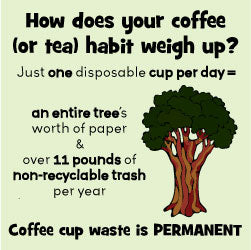
Many people prefer disposable paper cups over polystyrene, believing them to be better for the environment. The truth is, they aren't much better at all; in fact, because they are lined with a synthetic waterproof polymer, paper beverage cups are neither biodegradable nor recyclable. An astonishing amount, over 40% by some accounts, of solid waste in American landfills is either paper or cardboard. Much of this waste can be attributed to disposable coffee cups. If you are currently throwing away just one cup per day, you are responsible for consuming nearly an entire tree's worth of paper per year. Next time you're in line at your local coffeeshop, imagine for a minute each person in line as a tree that was cut down. If we truly want to save the environment, our "out of sight, out of mind" mentality regarding trash just won't cut it anymore. Have you ever considered how much waste we contribute to landfills through disposable coffee cups?

Doing the Math: How Do Your Daily Habits Stack Up?


While some say ignorance is bliss, like Stephen Colbert, we think truthiness is better. To create the table below, we compared the weights of three standard disposable cup sizes: a small paper cup (12 oz), a medium paper cup (16 oz), and a large polystyrene cup (22 oz). We then figured out how much trash one person can accumulate from a one-cup-a-day coffee, tea, or hot chocolate habit. These numbers are likely to confirm what you probably already knew in your gut: humans make too much trash!

One Cup a Day Accumulates How Much Solid Waste?*


In a Day (1 Cup)In a Month (30 cups)In a Year (365 Cups)
Small0.375 oz / 10.63 g11.25 oz / 318.93 g8.6 lbs / 3.9 kg
Medium0.5 oz / 14.17 g15 oz / 425.24 g11.4 lbs / 5.2 kg
Large0.25 oz / 7.09 g7.5 oz / 212.62 g5.7 lbs / 2.6 kg
*actual cups from coffeeshops were weighed for this data. Numbers may fluctuate slightly for different brands of cups, but sizes are standard.


Using this table, you can easily estimate how much waste you contribute to landfills by throwing out disposable hot beverage cups. Keep in mind that these totals don’t even include the added weight or volume of plastic covers and cardboard sleeves, nor the impact of double-cupping for comfort. While this information might leave you feeling discouraged, think of it as a timely wake-up call.
By opening our eyes to the truth, we become motivated to make positive life changes!

How You Can Help Reduce Disposable Cup Waste


We’ll be the first to agree that old habits die hard, but that doesn’t mean they are invincible. By making small, incremental adjustments in our daily lives, eventually the momentum builds, inspiring us to make even more positive changes. One person can make a difference, and that person can be you! Before buying your next hot beverage of choice, consider these simple suggestions for saving the world one cup at a time:

  • Take a break! Rather than getting your favorite drink “to go,” stop and smell the roses for a few minutes. Don’t forget to let your barista know you’ll be sticking around, and that he or she can serve your beverage in a washable mug (if possible).
  • Rinse and repeat! There is no rule that says you can’t reuse a disposable cup a few times before throwing it out. If you’re the type of person who buys coffee more than once a day, bring your first cup back and put a few additional miles on it.
  • Buy a travel mug! Most coffee shops are happy to use a cup provided by you. Look for stainless steel or ceramic (skip the plastic - for the environment, your health, and taste) reusable travel mugs that are easy to wash and won’t spill too easily. The easier it is for you, the more you'll enjoy using it. You can even buy a glass Mason or Ball jar (the best choice for the environment) with handles.
  • Repurposing is rad! No need to shell out extra cash and use up resources. Reuse a 16oz glass peanut butter, coconut oil, or other wide mouth jar. You can even outfit your new favorite mug with a jar cozy for added comfort and cuteness!

Know that you, as one person, can make a difference. Want an easy way to visualize the change you can make? For each cup saved, think of it multiplied by 1,000.

You may also like...


Is it Natural? What are the Labelling Rules?
5 Commonly Misused Natural Terms. Do you Know What They Mean?
What is Calendula, and Why is it Awesome for Your Skin?

Ecommerce Software by Shopify Craftybase inventory software for handmade sellers