Tuesday, April 14, 2015

Spring! (with Eggshells + the Moon)

It's finally here. For real this time. I hope.

The snow has almost disappeared, the flooded ground is beginning to dry, and the temperature hasn't dropped below freezing in about a week.

My hands are ready to get dirty.

I'm ready to garden.

This year, I wanted to try something different, something to make me feel more connected to what I'm doing with my little green friends. This year I'm gardening by the moon.

Moon gardening is an old traditional way to time your gardening tasks by the phases of the moon combined with the astrological sign the moon is travelling through. I don't know whether it works or not as I'm just beginning, but here are my little seedlings just one week after planting:


This is also the first year I've tried seeding into soil-filled eggshells. 

I've never had good luck with peat pots (they dry out so fast!), and I prefer a neat little seedling I can put directly into the dirt over transplanting out of reused food and other containers. If you have access to eggs that comes in a plastic container, you have a mini-greenhouse with your little pots.

To make eggshell pots, crack each egg carefully towards the small end of the egg. Pull the top off, use the egg, and put the top in your compost bin (or wherever you usually put your eggshells). Rinse the larger part of the shell in warm water, and poke 2-3 holes in the bottom with a pushpin. Once you have a dozen, fill with your soil blend and add seeds. Use a spray bottle to water, close the top, put in a sunny location, and wait for your little sprouts to show themselves.

Make sure to keep the soil moist, but not too wet. Find the balance.

(If you eat local eggs, or only have eggs available in paper-based containers, you can put the eggshells in a tray, and fill the tray with sand or small pebbles to keep the shells straight. Cover with plastic or a sheet of glass until you see sprouts.)

So far, I've planted sunflowers, tomatoes, spinach, lettuce, oregano, thyme, and basil.

What are you planting?

XoXo,
Lisa


Monday, January 27, 2014

The Fire Cider Fiasco

What is Fire Cider?
Have you heard of fire cider? It's a traditional herbal remedy often used in the wintertime. Thousands of people across the globe make this herb-infused vinegar as a preventative and cure-all. The recipe differs from person to person, but almost always contains garlic, onions, ginger, horseradish, and peppers, sweetened with honey to taste, in an apple cider vinegar base. I first learned to make it when I was in herb school back in 2000, although the formula I was taught contained cayenne instead of the more commonly used jalapeno. Personally I prefer honey-based elixirs over vinegars, but my personal taste aside, fire cider is a pretty well-known remedy in herbal circles everywhere, and thanks to the internet, is no longer limited to herbalists and grandmothers' kitchens. Search for it on Pinterest, or put it into a Google search and you'll get thousands of hits, a mix between DIY recipes and indie herbalists offering their pre-made fire ciders.

Who Invented Fire Cider?
Probably the most famous proponent of fire cider is Rosemary Gladstar, founder of Sage Mountain and the Women's Herbal Conference. Often referred to as the godmother of herbal medicine, almost every herbalist in New England, and many across the US and across the globe, have learned something from Rosemary, through her published books, online or in-person courses, or through word of mouth. Rosemary is a guiding light in the herbal community, and most people who know, make, and/or use fire cider have heard of it through Rosemary. Even though so many people learned from her, Rosemary doesn't claim to have invented it, and instead credits traditions that came before her.

Who "Owns" Fire Cider?
Nobody. It's a remedy that belongs to all of us. It belongs to "the people". It's a remedy to be shared from person to person, through generations, across state, country, and continental lines. Nobody really knows who invented fire cider, and nobody owns fire cider. 

Or, that's what we all thought.

Until yesterday.
(For me at least. For some it was a bit earlier.)

The Theft of "Fire Cider" From the People.
Yesterday Ryn from The CommonWealth Center for Herbal Medicine shared a blog about fire cider on their Facebook page. Or, more specifically, Fire Cider®. A company, Shire City Herbals, right here in MA, had trademarked the term "fire cider". I couldn't even get halfway through his blog before going to the USPTO to search for the trademark. I was sure there had to be a mistake. How could something so universal be trademarked? Yet there it was. Filed on 04/20/12 and officially registered on 12/18/12. Yes, in 2012

How did it take us all so long to find out? I'm not sure, but I can only guess that nobody knew until Shire City Herbals started enforcing their trademark rights by having sellers like The Withered Herb remove their fire ciders from Etsy.

I finished the article, read the response by Shire City Herbals, clicked through all the links, and became really angry. No, livid. I rarely swear, but every dirty word in the book popped into my head. You know in the Christmas Story when Ralphie gets back at Farkus and all the kids stand there with their mouths gaping, in shock at the words that came flying out of his mouth? That was happening to me, but I managed to keep it contained.

Protesting the Fire Cider Trademark
I posted my (censored) thoughts on Shire City Herbal's facebook page, spread the word to a few more, and internally tried to follow the lead of more understanding protesters by wondering if maybe it had actually been just a mistake. Maybe they didn't really know that fire cider was such a universal term. Maybe Shire City would just apologize and release the trademark. Maybe we could even run a crowdfunding campaign to help them get a new trademark. I know how expensive the process is. I went through it less than two years ago. I decided to sleep on it.

But here's the thing.

I woke up thinking about it.

Thinking about how they claimed it. Thinking about how they said, "I did not invent the name Fire Cider, I got that percolating through the herbalist underground, without attribution" (Ryn has this quote in his blog, along with a link to the original posting of it on Facebook).

They admit to taking the name. Here they are practically saying that the name belongs to them because they were the first ones to think of trademarking it.

I was happy to see that someone created a Change.org "Revoke Fire Cider Trademark" petition. Even happier to see that right now, as I'm writing this, there are over 1600 signitures, less than 24 hours after it was made. Especially after reading their response to all the protesting, which alludes to their invention of fire cider. Yes, I'm serious. Read it.

What We Want (and why we want it)
I can't speak for everyone, but most of us agree on these things:

  1. Shire City Herbals DID NOT invent fire cider. 
  2. Shire City Herbals SHOULD NOT own "fire cider", as it is a universal term for a generic product. There is not one fire cider. Everyone has their own formula. Absolutely, they should protect their product. Just not the universal term.
  3. Shire City Herbals SHOULD release their trademark on "fire cider" and give it back to the people.
Being able to trademark a universal trade term such as "fire cider" sets a scary precedent. Who will be the first to trademark "elderberry syrup" or "herbal bitters"? Those are both as universal as "fire cider". It's not a far stretch to see this happening if Shire City Herbals is allowed to keep "fire cider".

What You Can Do
Shire City Herbals has had a fair chance to make things right, being contacted directly by Rosemary Gladstar (see below), and other herbalists, but they hold fast to their "too bad, so sad" attitude. So, it's up to us to take some action to guide them in the right direction.

Write to Shire City Herbals and let them know how you feel. Contact Brian, Amy, or Dana directly by using any one of their names "@firecider.com". Or, go to their facebook page. Speak your mind, but try to be civil. We want to be taken seriously, not blown off as "venters" as we have been so far.

Their brand of fire cider is sold at stores all over Massachusetts and across the country. Let your local health (or other) store owner know what is going on. If you plan on boycotting, let them know that as well.

Sign the petition.

EDIT: I don't know how I could forget this one, but spread the word! Share this blog, share the original blogs by Herbal Revolution and A Withered Herb (these two blogs are how many of us found out), share the petition, share your words. Share one, share all. Just make sure that the word gets out. Shire still doesn't seem clear on exactly what they've done here. (Their newest response on their facebook page begins, "Fire Cider is not considered a generic term by the government- this is the problem!!!")

EDIT II: There is also an open facebook group called Fire Cider that you can join to keep updated.

EDIT III: Last night (01/27), Shire posted on their Facebook page asking for two weeks. We (as a group) want to honor this by not sending them anymore emails. Give them a chance to think. But, don't stop spreading information to friends, family, and retailers, and keep collecting signatures. Make sure people are aware.


A Message From Rosemary Gladstar
I emailed Rosemary last night, and was not expecting a response, but I got one. This was not sent to just me, but several others:

"Dear Lisa,  thank you for contacting me. I just found out about this situation a few days ago and, of course, was surprised and extremely disappointed that someone would think they had the right to trademark a name and product that's been in public use for over 3 decades.   I had written to the gentleman directly, hoping to be able to persuade him that this wasn't his name to trademark as I didn't want it to go public without giving him the opportunity to rescind his trademark. Unfortunately, he seems pretty set in his 'right' to own the name even though I first made  fire cider and gave it its name over 35 years ago.  In the meantime I've taught hundreds if not thousands of people to make it, who have them taught others….this product is clearly a 'peoples medicine' and isn't to be 'owned'.   Of course, as with most herbal products, its based on old formulas, so it's even pretentious for me to say 'I made it up'.    My grandmother used herbs, vinegar and honey and she probabily learned from her grandmother.  We all learn from one another….. 

My guess is that this man or his sister (I think its actually his sister or sister in law who makes the product) learned how to make it from someone who read the directions in my book or from one of my classes, or, perhaps, one of my students.   They thought it was a great recipe, which it is, and decided to make it for others, as so many others have done, and have been doing for centuries. That's the beauty of herbs, learning and passing the information on. Like so many others, he, too,  decided to make it and sell it. All great, but then to lay claim to something that's clearly not his to lay claim, is wrong.  And to then tell others they can't use the name anymore!! What am I suppose to do, remove it from all of my literature, copyrighted books, class handouts and correspondence course?! 

Personally, I don't think that a good response is necessarily anger, but rather a clear message that this isn't to be tolerated in the herbal community.  That we  as a community are here to teach, educate,  heal, and share information,  recipes, and ideas.  Furthermore,  with something like Fire Cider that's been in use for so long, and a product whose name is already well known and circulated in the world, he nor anyone else has the right or privilege to take ownership of it.   He can certainly make the product and even call it Fire Cider, but if he wants to trademark it, he needs to make up his own name, and, ideally, a product that's uniquely his own.  If we allow Fire Cider to be trademarked, then it sets a precedent.  Next we'll see Rosemary's Famous Face cream trademarked or Kloss's lineament, Kava Chai, Chaga Chai, etc etc. Its one thing when you make a totally unique product and give it a name that's not been used before. But this clearly isn't the case in this situation.  He may have brought the trademark and thinks he owns the formula and name, but  he's doing it at a great cost to himself, and his company.  

I spend hardly any time on the internet or Facebook so am behind the times in what information is being passed along  in 'cyber space'.  But please do feel free to post this response. What I would suggest is for people to actively respond to this person with a kind but clear and straightforward  that this isn't going to be  tolerated.  He needs to rename his product.  Fire Cider was around long before he ever starting making and using it and that unless he recinds on the trademark, we will spread the word like wildfire. He may end up owning the name but he won't  have a very popular or successful business.   We also needed to cc Etsy on all correspondence, as  they too, need to understand the situation.  

Thank you again for contacting me.
With you in herbal ways, 
Rosemary Gladstar"

XoXo, 
Lisa


Ecommerce Software by Shopify Craftybase inventory software for handmade sellers

Thursday, January 2, 2014

Annual Birthday Sale

It's another year for Wunder Budder!

Ok, it's another year for everyone, but January 2014 marks the end of our fourth year and beginning of our fifth year.

What? You thought we started in 2002, not 2010, you say?

That's true. Someday we'll figure out a way to make this not confusing.

If you haven't heard the story yet... From late 2002 to late 2009 Wunder Budder was a seasonal home business, and products were only available through me directly, in person, or through someone I knew. It was more of a hobby that I paid taxes on, a dream I didn't want to let go. I'm glad I didn't.

Through a series of events in late 2009/early 2010, I decided to make it a full-time thing, left school, rented a studio to work out of, and made my first website. The rest is Wunder Budder history.

January of 2010 is when Wunder Budder became "real", so that's when we celebrate Wunder Budder's birthday.

It's our birthday and we're happy you're here (here, as in part of it all!), it's the new year, it's wintertime (aka Wunder Budder season), and it's the perfect time to start making changes.

It's also the perfect time for a sale. So that's what we do.

Once a year everything on our website goes on sale. Everything is 5%-25% off.

It's the perfect time to stock up on items, try out new things, or just pick up a couple of your favorites.

The Annual Birthday Sale runs from 01/01/14-01/15/14 or as supplies last. The sale is on our existing stock only, so get it while you can!

I hope you all have the happiest and healthiest 2014, 
XoXo,
Lisa


Ecommerce Software by Shopify Craftybase inventory software for handmade sellers

Monday, December 16, 2013

Winter Aromatherapy Quick Tip

Winter Solstice is coming up,
but the cold, dry weather is already here.
We need all the help we can get to keep our insides and outsides from becoming dehydrated.
One easy tip?
A simplistic, passive humidifier using just a bowl of water on top of your radiator.
Bonus: add essential oils to the mix.


Although this works best with the old-style radiators, even small baseboards radiators can be used by using ramekins or finger bowls instead of full-sized bowls (just fill them up more often).
Just fill your bowl (or ramekin, or mug, or whatever heat and water-proof vessel you choose) with water.
Add 3-5 drops of essential oils.
Put on your radiator.
And that's it!
Check every couple days and refill as needed.
The radiator gently heats the water, and the water gently heats the oil.
Water vapor and a subtle aroma are released into the air.
Don't know where to start? Try one of these combinations:

4 drops eucalyptus
1 drop peppermint

2 drops peppermint
3 drops bergamot

2 drops juniper
2 drops lemon

3 drops lavender
2 drops rosemary

1 drop German chamomile
3 drops lavender

Happy winter!

XoXo,
Lisa


Ecommerce Software by Shopify Craftybase inventory software for handmade sellers

Friday, October 11, 2013

DIY Natural Air Freshener

DIY Natural Air Freshener

Make Your Own Natural Air Freshener at Home

in just five easy steps:

  1. add 1/4 cup baking soda to a glass bowl
  2. add 5-10 drops essential oil
  3. mix and crush lumps
  4. stir in 1/2 cup dried flowers
  5. pour into decorative bowl or vase
In this example I used lavender, but any dried flower or herb will work. Match up the essential oil for best results (e.g. dried rose petals with rose absolute or essential oil, cedar chips with cedar essential oil). For a light oil like lavender, 10 drops is better, but for heavier oils like rose or cedar, less drops will work. Mixing the baking soda with the essential oils before adding the herbs allows for better blending.

Once in the bowl or vase, this freshener will help pull the bad aromas from the air while releasing the good aromas. How does that work? Magic! No, just kidding. I don't know how it works, I just know it does, and it's long lasting. A blend I had in my bedroom (it was lavender) lasted for six years before a spill caused me to stop counting. Just give the container a little shake whenever you want to release fresh aroma.

Although this is a natural air freshener, keep the mixture away from kids and pets, or anyone who might think it's a good idea to eat it (don't eat it).

XoXo,
Lisa


Ecommerce Software by Shopify Craftybase inventory software for handmade sellers

Tuesday, September 24, 2013

You Don't Know What Homeopathic Means.

Ok friends, it's rant time again.

I'd like to scream this to the world...

Homeopathic is not the same as natural.
Homeopathic is not the same as holistic.
Homeopathic is not the same as botanical.

If you use this word for anything other than one small branch of holistic medicine,

you don't know what homeopathic means,

so please find out what it means or stop using it. Especially if you're a writer/blogger. Or any part of a natural healthcare or natural skincare field. (If you're a person not involved in these fields, and you're misusing this word, it's no wonder since "authority"-types are doing it.)

At a herbal conference earlier this year I continuously heard people call small doses of tinctures "homeopathic doses". I don't know what teacher is telling their students that small means the same as homeopathic, but it's wrong. So wrong. This was especially disturbing because if anyone (other than a homeopath) should know what homeopathy is and isn't, it's a herbalist.

But, this rant was brought on by an article on natural beauty products. Not quite as disturbing, but just as annoying.

Why does it bother me so much when this word is constantly used incorrectly? Because it would be like calling all colors blue, or all foods pizza, or all mammals cats. It's just wrong. Completely.

So, what is homeopathy?

It's a branch of holistic medicine using remedies made in a very specific way. These remedies are the only things that can be called homeopathic. A homeopathic remedy is created by making a "mother tincture", and then repeatedly diluting the tincture using a technique unique to homeopathy. The end result is an energetic medicine with none of the original (botanical or other) ingredient left in the menstruum (the liquid). It's a fascinating and controversial field, but unless you are practicing it or using it, all you need to know is this:

All homeopathy is natural (some are even made from natural poisons), but not all natural is homeopathic; all homeopathy is holistic, but not all holistics are homeopathic; all homeopathy is not botanical (there is even a remedy made from fire!), and not all botanicals are homeopathic.

So, please, help me stop this insanity.

If you hear or read someone incorrectly using the term, gently let them know that homeopathy is a branch of holistic medicine, not a general term. With bloggers and other writers, some herbalists, and others continuously misusing the term, it's no wonder that so many people are confused by the terminology.

Lets set the world straight.

Also see 5 Most Commonly Misused Natural Terms for more terms commonly confused.

XoXo,
Lisa


Ecommerce Software by Shopify Craftybase inventory software for handmade sellers

Monday, August 26, 2013

Martha Stewart's American Made Nominee!

Martha Stewart's new American Made program (this is the second annual) supports handcrafted, American-made business. This year, Wunder Budder is a nominee!

There are six categories: food, craft, design, style (this includes skincare, and is the category for Wunder Budder), technology, and garden. The winner of each category will win a gift basket, a feature on the American Made website, and a mention on Sirius radio. The exposure alone could change the life of a business (hopefully Wunder Budder's!), but these category winners will go on to compete for the grand prize: $10,000, a trip to the American Made Workshop, and a feature on marthastewart.com!

Wunder Budder stands a chance to win it all, but not without your help. The contest is entirely based on votes. Entirely. The only way to win is to get the most votes, and the only way to get the most votes is to ask all of you, my friends and Wunder Budder fans, to cast yours. You can vote daily, and you can vote up to six times per day (yes, you can cast them all at once!). To get people involved, American Made is entering each vote to win a prize (AmericanExpress gift cards and Martha Stewart books, some signed).

During the voting period (08/26/13-09/13/13) I'll be posting on Facebook and Twitter daily to remind everyone to vote, and to make sure I catch everyone. Twitter feeds are so fast moving, most people probably won't notice all the tweets promoting the contest, but Facebook is more personal. If I pop up in your feed five times a day, you'll probably get sick of seeing me! But, on average, each Facebook post is only been seen by 2-8% of fans. At best, it's 20%, and that's only with a LOT of interaction: comments and sharing. So, although a few of you will see every post, the majority of you will see maybe one. Because of this, I'll have to post a lot to make sure the link is seen by a large number of people. To make up for all the posts, I'll be offering daily specials starting tomorrow* - a different special every day (except for Labor Day Weekend). The code will be posted in the first comment every time the American Made contest link is shared, so keep an eye out for them. That you for all your love and support...


XoXo,
Lisa

*Unfortunately my profile page, along with many other nominees', has been down for most of the day. This very frustrating turn of events means that I didn't promote today and lost almost an entire day's worth of votes (who wants to be directed to a page that won't load??). Things seem to be back up now, so hopefully they stay up. But now I need to catch up with all the people who could access their pages all day!


Ecommerce Software by Shopify Craftybase inventory software for handmade sellers

Tuesday, August 6, 2013

Popular Diets, Commonly Confused: Vegan, Vegetarian, Pescatarian

(originally posted on www.wunderbudder.com on 01/22/13)

With constantly changing opinions on what foods are the healthiest, and what foods we should be avoiding, there are new diets emerging on a regular basis. From fad diets, to weight-loss plans, to entire lifestyle changes, it can be hard to keep track of which diet is which. Even three of the longest-standing, most common, and most well known diets are continuously confused with each other. Everyone knows, or at least has heard of, a vegetarian (a term used for over 150 years), a vegan, or a pescatarian, but do we all know what those terms really mean?

Vegans don't consume any animal (mammal, bird, fish, etc.) flesh or products, or any products made by animals (like eggs, dairy, and honey), or any products in general that directly lead to the exploitation, injury, or death of any creatures. Living the vegan lifestyle also includes not wearing or using any animal products, like leather or fur. Vegan is a more recent (still over a half-century old) term for "strict vegetarian".

Vegetarians don't consume any animal flesh, or products made from animals (mammal, bird, fish, etc.), but may consume products made by animals, like eggs, dairy, or honey. Although many vegetarians choose not to wear or use animal products, the vegetarian lifestyle is less strict than vegan and some vegetarians use certain products like leather boots or hand-made drums made from "by-products" (e.g. skin) of the meat industry. Some vegetarians categorize themselves as lacto- or ovo- (or lacto-ovo-) vegetarians if they eat dairy or eggs, respectively, but the term vegetarian has generally come to include eating both dairy and eggs and usually doesn't need to be categorized.

Pescatarians, the most recently (still a couple decades old) defined of the three, are similar to vegetarians, but fish is included in their diets. The distinction between vegetarian and pescatarian is important to make, but being newest, it is also the most often confused. Calling a person who eats fish a "vegetarian" is not only confusing to everyone, it's also incorrect. Pescatarians eat fish, but do not eat any other animals or products made from animals.

Although these diets can seem restrictive, what they do include are fresh vegetables, leafy greens to tuberous roots, grains, nuts, seeds, fruits and berries, and beans: a food list with an infinite number of combinations and flavors.


You may also like...


Animal Ingredients Hidden in Food
5 Most Commonly Misused Natural Terms.
What is Aromatherapy?


Ecommerce Software by Shopify Craftybase inventory software for handmade sellers

Hidden Animal Ingredients


(originally posted on www.wunderbudder.com on 02/01/13)

9 Common Animal Ingredients, Uncommonly Known:


Carmine (or Natural Red #4)


Sometimes under other names, such as carminic acid or cochineal extract, this red food coloring is made by crushing the bodies of female cochineal scale insects, and is found in foods from bottled juice to candy to yogurt.

Casein (or Caseinogen)


Ironically, this milk protein is commonly found in "dairy-free" cheeses, but can also be found in other foods, and in household items like paints and adhesives.

Gelatin


A protein extracted from the collagen of animal bones and by-products from slaugherhouses (generally cows and pigs), gelatin helps food stick together and is in things like marshmallows, gummy candies, and gel-caps. Kosher gelatin is usually made from kosher fish, but may come from specially processed cows. Vegetarian gelatin is agar, a gel-like substance found in red seaweed.

Isinglass (or Fish Gelatin)


Extracted from fish bladders, this collagen is used in the processing of some wine and beers, but doesn't remain in the final product.

Lanolin


Lanolin is excreted from the oil glands of sheep and is extracted from the wool after shearing. It's used in skincare, haircare, and cosmetics, and is a common ingredient in lip balms marketed as "natural".

Rennet (or Animal Rennet, Enzymes)


Made from the stomach of young mammals (usually calves), rennet is used in cheesemaking. Many cheeses contain animal rennet, but also may use vegetarian rennet, from vegetable sources, or microbial rennet, from bacteria or fungus.

Shellac ( or Gum Lac), Lac Dye


Secreted by the lac beetle, a scale insect, shellac is used as a coating for candy and pills, and in other items from glue to furniture polish to lipstick. Shellac is sometimes labelled as gum lac. The crushed shells of the lac beetle are used to make lac dye.

Vitamins & Fortified Foods


Not all vitamins and fortified foods contain animal products, but those that do are rarely labelled. Most common: vitamin D from lanolin and Omega 3 from fish.

White, and other Refined Sugars


Although sugars themselves are vegan, they are sometimes processed with bone char, used to "bleach" (lighten) the sugar, but will not be listed on the label. "Unbleached" sugars are not processed with bone char.


Want more? Check out...


What is a Vegan, Vegetarian, Pescatarian?
5 Most Commonly Misused Natural Terms
Why Use Natural Lip Balm?

Ecommerce Software by Shopify Craftybase inventory software for handmade sellers

Monday, August 5, 2013

The Cost of Disposable Coffee Cups

Coffee Cup Waste

(originally posted on www.wunderbudder.com on 02/27/13)

Saving the World One Cup at a Time...

"Science may have found a cure for most evils; but it has found no remedy for the worst of them all - the apathy of human beings" - Helen Keller

Though we may not want to admit it, we are all guilty of indifference at some point in our lives. To function successfully in today's society, it is necessary to shut out the madness from time to time. On the other hand, apathy and ignorance (the true sense of the word) are taking a heavy toll on ecosystems the world over. While there is nothing wrong with protecting ourselves from too much negativity, Earth, our home that we depend on for our survival, deserves our protection as well. At Wunder Budder, we are firm believers that, when considered collectively, small changes can make a big impact on the future of our planet. By curtailing our own wasteful habits today, we reduce the amount of trash piling up in landfills and create a better world now and for our future.

How Disposable Cups Impact the Environment:


Disposable cups for hot drinks are generally made out of either polystyrene or paper. Certain product characteristics make these containers difficult, or even impossible, to recycle. By now, most of us are aware that polystyrene cups are bad for the environment, but few people realize that disposable paper cups are just as problematic.

Disposable Polystyrene Cups


Commonly referred to by the brand name Styrofoam, disposable beverage cups made of this expanded polystyrene (EPS) are deeply despised by concerned environmentalists. While this notoriously carcinogenic petroleum-based substance is lighter than paper alternatives, the sheer volume of EPS contained in landfills is the real problem. It takes up a lot of space, and nearly incapable of biodegrading, EPS decomposition requires at least 500 years. You may have noticed that some polystyrene cups and containers sport a #6 recycling logo, yet many towns fail to include this in their curbside program. Though it is possible to make insulation, packing materials, and other foam items from recycled EPS, the current demand is still relatively low.

Disposable Paper Cups


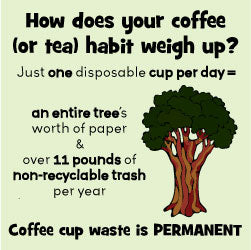
Many people prefer disposable paper cups over polystyrene, believing them to be better for the environment. The truth is, they aren't much better at all; in fact, because they are lined with a synthetic waterproof polymer, paper beverage cups are neither biodegradable nor recyclable. An astonishing amount, over 40% by some accounts, of solid waste in American landfills is either paper or cardboard. Much of this waste can be attributed to disposable coffee cups. If you are currently throwing away just one cup per day, you are responsible for consuming nearly an entire tree's worth of paper per year. Next time you're in line at your local coffeeshop, imagine for a minute each person in line as a tree that was cut down. If we truly want to save the environment, our "out of sight, out of mind" mentality regarding trash just won't cut it anymore. Have you ever considered how much waste we contribute to landfills through disposable coffee cups?

Doing the Math: How Do Your Daily Habits Stack Up?


While some say ignorance is bliss, like Stephen Colbert, we think truthiness is better. To create the table below, we compared the weights of three standard disposable cup sizes: a small paper cup (12 oz), a medium paper cup (16 oz), and a large polystyrene cup (22 oz). We then figured out how much trash one person can accumulate from a one-cup-a-day coffee, tea, or hot chocolate habit. These numbers are likely to confirm what you probably already knew in your gut: humans make too much trash!

One Cup a Day Accumulates How Much Solid Waste?*


In a Day (1 Cup)In a Month (30 cups)In a Year (365 Cups)
Small0.375 oz / 10.63 g11.25 oz / 318.93 g8.6 lbs / 3.9 kg
Medium0.5 oz / 14.17 g15 oz / 425.24 g11.4 lbs / 5.2 kg
Large0.25 oz / 7.09 g7.5 oz / 212.62 g5.7 lbs / 2.6 kg
*actual cups from coffeeshops were weighed for this data. Numbers may fluctuate slightly for different brands of cups, but sizes are standard.


Using this table, you can easily estimate how much waste you contribute to landfills by throwing out disposable hot beverage cups. Keep in mind that these totals don’t even include the added weight or volume of plastic covers and cardboard sleeves, nor the impact of double-cupping for comfort. While this information might leave you feeling discouraged, think of it as a timely wake-up call.
By opening our eyes to the truth, we become motivated to make positive life changes!

How You Can Help Reduce Disposable Cup Waste


We’ll be the first to agree that old habits die hard, but that doesn’t mean they are invincible. By making small, incremental adjustments in our daily lives, eventually the momentum builds, inspiring us to make even more positive changes. One person can make a difference, and that person can be you! Before buying your next hot beverage of choice, consider these simple suggestions for saving the world one cup at a time:

  • Take a break! Rather than getting your favorite drink “to go,” stop and smell the roses for a few minutes. Don’t forget to let your barista know you’ll be sticking around, and that he or she can serve your beverage in a washable mug (if possible).
  • Rinse and repeat! There is no rule that says you can’t reuse a disposable cup a few times before throwing it out. If you’re the type of person who buys coffee more than once a day, bring your first cup back and put a few additional miles on it.
  • Buy a travel mug! Most coffee shops are happy to use a cup provided by you. Look for stainless steel or ceramic (skip the plastic - for the environment, your health, and taste) reusable travel mugs that are easy to wash and won’t spill too easily. The easier it is for you, the more you'll enjoy using it. You can even buy a glass Mason or Ball jar (the best choice for the environment) with handles.
  • Repurposing is rad! No need to shell out extra cash and use up resources. Reuse a 16oz glass peanut butter, coconut oil, or other wide mouth jar. You can even outfit your new favorite mug with a jar cozy for added comfort and cuteness!

Know that you, as one person, can make a difference. Want an easy way to visualize the change you can make? For each cup saved, think of it multiplied by 1,000.

You may also like...


Is it Natural? What are the Labelling Rules?
5 Commonly Misused Natural Terms. Do you Know What They Mean?
What is Calendula, and Why is it Awesome for Your Skin?

Ecommerce Software by Shopify Craftybase inventory software for handmade sellers

How to Make Ginger Honey

How to Make Ginger Infused Honey

(originally posted on www.wunderbudder.com on 02/06/13)

Ginger + Honey = Love.

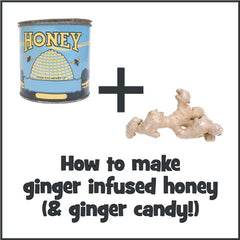
Honey and ginger do amazing things when they get together. The spiciness of ginger is perfectly calmed with sweet flowing honey, creating a balance of flavor you'll never want to be without again, and after today you'll never have to be. It's very easy to make ginger honey, and the best part? You also end up with spicy ginger candy!

Besides the taste, ginger and honey together are a must-have in your natural prevention of colds/other seasonal illness plans. Both have long been used to prevent colds and aid in a speedy recovery, and ginger is also well-known for relief from nausea caused by motion sickness or excessive gas. Honey can be used to soothe dry throats and ease coughs from scratchy throats, and many people find taking local honey during allergy season relieves their symptoms.

Add ginger honey to your tea, desserts, smoothies, or take a spoonful on it's own. It also makes a great gift!

What you will need


1 cup freshly sliced ginger root
2 cups local raw honey
double boiler or two sauce pans or crockpot
metal strainer (or other heat-resistant strainer)
two clean glass jars with tops (or other air-tight containers)
cookie sheet (or wax paper)
15 minutes prep time, 4 hours minimum (up to 8-12 hours) heating time (Don't be thrown off by the length of time! It can be split up if needed.)

How to make ginger honey


Set up the double boiler. If you don't have a double boiler, you can improvise by using a smaller saucepan resting in a larger saucepan (add water to the bottom pan). You can also use the ring from a canning jar to create a barrier between container and heat, by placing the ring in the bottom of a saucepan, placing a canning jar or glass measuring cup on top of the ring, and adding enough water to cover about an inch or two of the glass. For convenience, you can also use a crockpot. Even on the lowest setting, a crockpot can still be too warm for most herbal preparations, but if this is your only option (or the only option you like), use it.

Take fresh ginger root, and thoroughly wash (scrub it like a potato), leaving peel on. Cut the root thinly, in slices averaging 1/16 inch to 1/8 inch (thinner when cutting a large root, thicker when cutting a small root) until you have about 1 cup. Making herbal food products is rarely an exact science, so don't worry about being exact while slicing or measuring. Add the sliced ginger to the pot.
Measure 2 cups of local raw honey (local is especially important if you are trying to ease seasonal allergy symptoms), and add it to the pot with the ginger.

Turn the stove onto medium low until the water (not the honey!) starts bubbling (light, small bubbles, pre-simmer), then turn it down to the lowest setting. If you're using a crockpot, turn it on to the lowest setting. Cover, and wait. If you're using a jar or measuring cup, lay tin foil over the top, pressing down on the edges just enough for it to stay on (not too tight, there should be some air movement).

The waiting time will vary (see Tips, below), but the honey should warm for at least four hours. Eight to twelve hours is ideal. Keep an eye on the amount of water in the pan and add water as needed.
When the honey is finished, strain into a clean glass jar (a Mason jar, Ball jar, or reused food jar like a glass peanut butter jar) or another heat proof container. Any type of small strainer will do, but metal is the easiest to clean honey from, and a small metal tea or sauce strainer is ideal. One or two layers of cheesecloth can also be used. Leave to cool, then cover.

Spread ginger pieces in a single layer on a baking sheet or a layer of wax paper. Leave to cool, and then put into a small jar or other air-tight container. The ginger candies will harden slightly, but will always remain sticky.

Your ginger honey and candy should be stored in a cool, dark place.

Ginger Infused Honey Tips


Make the honey on a day where you know you will be home for at least four hours, but if you need to split up the process, you may. Leave the honey covered and remove from heat until you can warm it up again.

To decide when the ginger honey is ready, taste a piece of ginger. If the ginger candy tastes too spicy, leave the honey for longer. Test every 1-2 hours. Like stated above, it's not an exact science, so you have freedom to choose how spicy you want the candy to be (the honey can be easily adjusted).
If this ginger infused honey is too strong, add some plain honey to taste and stir well. If you want it stronger, double infuse the honey by straining the ginger candy when ready, putting the honey back in the pot, and adding a new batch of fresh ginger.

As an alternative to heating, you can add all ingredients to a jar and store for a few weeks, but gentle, long heating will give a better result.

Once you get the hang of making infused honey, you can use other herbs and spices to make flavored honey for eating, cooking, or even for natural medicines.

Disclaimer that needs to be added because at some point someone ruined everything for the rest of us: This is for educational purposes only and is not intended to diagnose, treat, cure, or prevent any illness or disease.

XoXo,
Lisa

You may also like...

Lemons for Health!
5 Most Commonly Misused "Natural" Terms
Hidden Animal Ingredients in Food

Ecommerce Software by Shopify Craftybase inventory software for handmade sellers

Is it Natural?

(Originally posted on www.wunderbudder.com on 05/25/12)

It's time for my rant.

It's actually long overdue.

How many times have you seen a company or product making the "natural" claim, only to read the ingredients and have it be filled with 400 different types of alcohol, 300 petrochemicals, 200 preservatives, 100 words you can't figure out, and one natural, botanical ingredient? Ok, maybe that's an exaggeration, but I think you know what I mean.

There are basically NO rules for labelling something "natural", "botanical", or any other word you can think of that makes the product seem like something it's not. "Organic" has rules, but even labelling something "organic" means that it's 95% organic. What about the other 5%?? Exactly.
It makes me SO MAD, I can't even fully put words to it without sounding like a child having a temper tantrum. It's unfair to companies like Wunder Budder who aren't making false claims, but most importantly, unfair to consumers. Unfair to YOU. If you're not in the industry, how are you supposed to know what can and can't be called what? How are you supposed to know that anyone can call anything "natural" just because they feel like it? I'm telling you now, and I hope you spread the word.

READ THE LABELS! Alway, always, always, read the ingredient list on products you're buying. I can't stress this enough. You don't even have to know what all the ingredients are exactly. If it seems like it's not natural, it's not. Trust your instincts.

Can I just say it one more time?

There are NO rules for labelling something natural (at least not in the USA), so you MUST read the ingredient list!

This is the reason why we list Every. Single. Ingredient on all of our product labels and their descriptions online, and why we don't use anything like "flavor" or "fragrance". (Update 08/15/13: Well, we started adding some items that are fragrances in a more perfume-style. A few items have "natural fragrance" listed, but each one is blended in the studio using the same ingredients we use for all our other products. There are still no "fragrance" or "flavor" oils, don't worry! We didn't change our core beliefs that natural is the only way to go, we just wanted to expand our horizons.) If it's in it, we list it, so you always know exactly what you are using when you use Wunder Budder. If you have a question about any ingredients we use, check out our new Glossary of Good Stuff. If what you're looking for hasn't been added yet, or if you have more questions, please contact us.

End rant (for now).

XoXo,
Lisa

Read more about Commonly Misused Natural Industry Terms.

Ecommerce Software by Shopify Craftybase inventory software for handmade sellers

Goodbye Garden Grease!

Goodbye Garden Grease
(Originally posted on www.wunderbudder.com on 12/20/12)
 
Well, guys, here is it.
 
For the first time ever, I'm discontinuing a product.
Garden Grease.
 
This was never my favorite (if it was your favorite, keep reading, you won't be totally disappointed).
 
It was formulated with my mother in mind: an avid gardener, and someone who spends a lot of time working with her hands, whether it's installing a patio into her backyard, or carefully painting pictures of flowers. 
 
But, it never became what I meant it to be.
 
Originally, it was supposed to be creamier, lighter, and come in a larger container. More like cold cream than a salve. And, it was supposed to go along with a hand scrub made especially for hard working hands, but gentle enough to use regularly, even on the sometimes tender skin on the back of hands.
 
But, for reasons I can't remember now, it ended up as a salve. It was pretty nice, but it wasn't awesome, and it seems that most of you agree (it was, by far, the slowest selling product of 2012).
So, it's time to say goodbye.
 
For anyone who loved Garden Grease, it will be reincarnated in mid-2013 as a lighter cold-cream-ish salve, as it was originally intended.
 
And this time it will be awesome.
 
XoXo,
Lisa

What Happens When I Clean My Shower, aka I Love Baking Soda

(Originally posted on www.wunderbudder.com on 10/24/12)

My husband and I switch off who cleans the bathroom every other week. We have different preferences in cleaners (and soap, and shampoo). When it's my turn to clean the bathroom, I break out the baking soda for all three.

I take a bowl, add about a cup of baking soda, a squirt or two of peppermint Dr. Bronner's (or other natural castile soap), and get into the shower.

I add small amounts of water and stir with my fingers until a paste forms, about the texture of a light frosting. Then the fun begins!

The baking soda mixture goes on my face as a natural exfoliating cleanser, onto my hair as a deep cleaning shampoo, over my body as a deodorizing wash, and onto my shower walls as a non-abrasive powder cleanser. One bowl of "frosting", so many uses! It's just so cool!

Ok, yes, I do get easily excited. I like to think it's part of my charm. But, seriously, it's pretty awesome to get so many things done with one cleanser! At the very least, it makes cleaning the shower not so annoying.

Once everything is scrubbed, I rinse my face and hair. Then, I take my spray bottle filled with orange infused vinegar, and spray it onto the walls and let it do it's job, while I spray a little into my hair to remove any traces of baking soda. Then, rinse everything! What is left, is a sparkling clean shower and me.

And that is what happens when I clean my shower, and why I love baking soda.

XoXo,
Lisa

Kindness

 
XoXo,
Lisa
 

Salem BizBaz 2012 Thank You

(Originally posted on www.wunderbudder.com on 10/11/13)

The 2012 BizBaz in Salem was a success!

In fact, it was Wunder Budder's busiest show to date (and we've showing at fairs and festivals for ten years, long before we became a "real" business!).
 
It's hard sometimes. Pouring your entire life into something, and then holding it out for everyone to judge. It makes me feel like a child, smaller than the onlookers, hesitantly holding out my hands with my little creations cradled inside. Or, in this case, spread out upon a table.
 
Luckily, this is where my husband steps in. If you were at the Wunder Budder table during the BizBaz, it was probably him that you spoke to. I was in the background, jumping in to answer questions or talk with fans (love!).
 
Someday I may get better at this, or maybe I won't. It no longer bothers me that I can't be awesome at everything I do. (Ok, well, it bothers me a little, but I'm trying to learn to accept it.)
The feelings of vulnerability at shows makes me extra appreciative of all who stop by the Wunder Budder table.
 
I want to thank everyone who stopped by at the BizBaz this year. My friends and family who passed on hugs and words of encouragement, the already fans who introduced themselves to me (you guys totally made my day! really!), and all of you who made purchases and helped make the show so successful. Lots of love to all of you!
 
Next up: The Holiday Craft Market  on Nov. 10th in Beverly, MA. (thanks to the organizers who made extra space for a few of us returning vendors!)
 
XoXo,
Lisa

Just Live.

 
XoXo,
Lisa

Heads Up!

There are going to be some changes over at the dot com...

Last year (or maybe longer?), I moved this blog over to the website. And now, I'm moving it back.

It's all a learning experience, and now I'm learning that I want a more streamlined website. It helps me work more clearly, and helps customers find what they're looking for more easily.

So, heads up!

Over the next couple days I'll be moving the blog over here. Physically. As in, reposting every blog. Not every article, most of those will stay on the website, but all the blogs are coming here.

So if you follow this blog on a feed, you'll be getting tons of notifications! It may just take a day, or it may take a week, but then everything will go back to normal.

Hopefully a little better than normal.

XoXo,
Lisa
 

Wednesday, July 24, 2013

American Made Contest from Martha Stewart

I just entered.

It's a scary thing to put yourself out there purposely for people to judge you.

And that's what I just did.

Actually, I do it on a daily basis just having a business, but this feels different. It's more direct. People have to vote. And they judge you completely on your photos and two paragraphs of information where you're limited to 1000 characters. They judge you on your ability to convince them that you're awesome.

Especially with only 1000 characters. Or maybe it's better there's a low limit (I know I can get wordy!).

Anyway, here it is:

Martha Stewart - American Made 2013 - Nominee Badge

Check it out. Judge me. And hopefully vote for me. Voting starts at the end of August.

It only lasts for one week.

The shortest, most nerve wracking popularity contest ever.

XoXo,
Lisa

Tuesday, July 23, 2013

K.I.S.S. (not the band)

Keep It Simple, Stupid.

Although this saying, and its variations, have been around for decades, it's Michael Scott (from The Office) who taught me this lesson.

As I'm typing this, I think I may have written about this before, but it needs to be said again. Or maybe I just need to rant a little.

Keep It Simple (without the "Stupid" is much nicer, but with the "Stupid" in Michael Scott's voice is how it happens in my head).

Simple is how I like to do things. Sometimes I feel like I, and Wunder Budder, get judged for this. It could be all in my mind, because as I'm recently discovering, there are many things I've been tricked into thinking (it's a long personal story).  But, I do sometimes feel like all the years I've spent studying herbs (plus my in-depth certification in 2000), and all the years I've spent studying aromatherapy (again, plus my in-depth certification in 2003), are ignored because I like to keep it simple.

I love experimenting, but my go-to herbs are the same, especially for skincare. Why would I use 10 different herbs in a skin formula when just one would do, and do better? Not only that, but putting 10 different herbs in one formula, means that there is so little of each one, you can't actually benefit from any of them.

The same with oils.

If you follow the trends, you might see, or believe, that coconut oil is thought to be practically magic. It's not. You probably have heard how you can use it for everything from skincare to polishing wood. Although that's true, it's true of most oils. Multiple uses is not a special characteristic of coconut oil. On a scale of 1-10 for skincare, I give it a 5. It's not a bad oil by any means, but it's not the best. This is just one girl's opinion, but it's one girl who has experimented with practically every oil available for over ten years. It absorbs pretty well, so it's not super greasy, but it doesn't feel that great on the skin, and it doesn't last as long as others. Plus it smells really strong, which is a plus for some, but not for me. Unfortunately, since most people know very little about oils, they try the ones that are hyped the most and think they're as good as it gets. I made a limited edition body butter with a coconut oil base, purely because I kept being asked for it. I love it, this body butter, but coconut oil is still not at the top of my list.

But, this isn't supposed to be another rant on the trendiness of coconut oil, it's about keeping it simple.

If there are 10 oils in a blend, or 12, or 7, or any more than 3 in my opinion, you're not benefitting from them. Just like essential oils in an aromatherapy blend (any more than five is no longer a therapeutic blend, it's heading to a perfume), too many carrier oils is overkill. It serves no purpose, other than to make it (falsely) look fancy. Don't fall for it. K.I.S.S.

I don't mean to trash people who like coconut oil, or other small businesses like mine who make products with too many ingredients. I just want to spread the word that just because something is hyped, it doesn't make it better. And a product with too many ingredients just means you don't benefit from any of them.

Keep It Simple.